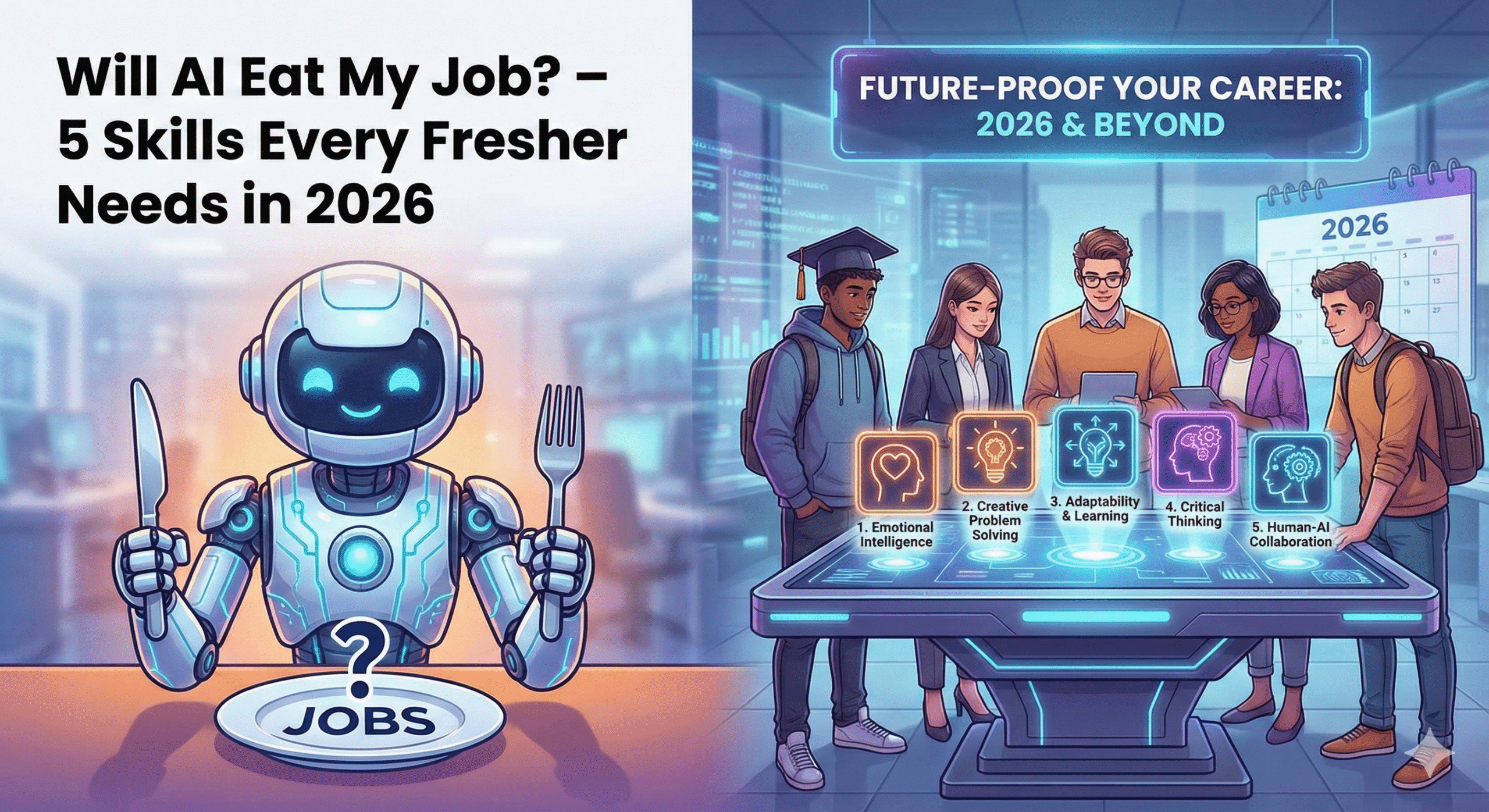
Will AI Eat My Job? 5 Irreplaceable Skills Every Fresher Needs in 2026
Look, I get it. You just finished school, maybe you have some student loans, and now every headline says that some fancy computer program is going to take your paycheck before you even get health insurance. It’s scary, yeah, but honestly, most of the talk about AI eating the world is just noise.
The 2026 Reality Check
The question isn’t just “Will AI eat my job?” anymore—it’s “How fast can I learn to work alongside it?” As we move through 2026, the global job market is undergoing its most significant transformation since the Industrial Revolution. While headlines often scream about displacement, the real story is one of restructuring.
Research shows that while 37% of companies expect to replace certain roles with AI by the end of this year, the World Economic Forum predicts that 97 million new roles will emerge globally. For a fresher entering the market today, the fear is real, but the opportunity is unparalleled. AI has evolved from a “chatbot” to “Agentic AI”—autonomous systems that execute complex workflows. If your value is just “producing output,” you are at risk. If your value is owning the outcome, you are the future.
Context Engineering (The Evolution of Prompting)
In 2024, everyone wanted to be a “Prompt Engineer.” By 2026, simple prompting is a basic commodity. The high-value skill has evolved into Context Engineering.
What is Context Engineering?
It is the systematic design of the information environment that surrounds an AI. While prompting is asking a good question, context engineering is providing the AI with the right data, historical files, and “mental” frameworks before it even begins to answer.
- The Skill: Moving from “Write a marketing plan” to “Designing a data pipeline where the AI analyzes our last 3 years of sales, current competitor pricing, and local cultural trends to suggest a localized campaign.”
- Why it’s Safe: AI can process data, but it cannot understand the “Why” behind a unique business strategy. Freshers who can “feed” the AI the right context will lead teams.
Emotional Intelligence (EQ) and The “Human Touch”
The Economic Survey 2025-26 highlights a massive trend: as technical tasks become automated, “Human-centric” roles are seeing a 30% surge in value.
Why EQ is Your Shield
AI can simulate empathy, but it cannot feel it. In a workplace dominated by screens and algorithms, the ability to build genuine trust is a premium luxury.
- Conflict Resolution: AI can suggest a compromise, but a human must navigate the ego, fear, and nuances of a boardroom or a client meeting.
- Leadership: Leading a team in 2026 isn’t about assigning tasks (AI does that); it’s about providing accountability and inspiration.
Table: Human vs. AI Skill Comparison 2026
| Task Category | AI Capability (2026) | Human Advantage |
| Data Analysis | 99% (Automated) | Strategic Interpretation |
| Content Creation | High Speed/Low Originality | Emotional Resonance & Brand Voice |
| Complex Reasoning | Logical, but biased | Ethical & Contextual Judgment |
| Physical Work | Limited (Robotics) | High Dexterity & Adaptability |
Critical Thinking and “Hallucination Hunting”
In 2026, we are drowning in AI-generated “workslop”—low-quality content that sounds correct but is factually hollow. The most valuable fresher is the one who acts as the Final Gatekeeper.
- The Skill: Developing a “Subject Matter Expertise” (SME) so deep that you can spot when an AI model is confidently lying (hallucinating).
- Actionable Tip: Don’t just use AI to get an answer; use it to generate three versions of an answer and use your critical thinking to synthesize the most accurate one.
Radical Adaptability & Learning Agility
The “half-life” of a technical skill is now estimated at just 5 years. This means half of what you learn in college will be obsolete by 2030.
The “Skill-First” Hiring Revolution
Companies like Google, Microsoft, and Indian tech giants are moving away from degree-based hiring toward Skill-Based Hiring.
- The Skill: The ability to “unlearn” an old tool and “master” a new AI agent in a weekend.
- The Portfolio: In 2026, a GitHub link or a “Proof of Work” portfolio is more valuable than a 10-page CV.
Ethical Judgment and AI Governance
As companies integrate AI into every department—from HR to Finance—they face a “Regulatory Tsunami.” Who ensures the AI isn’t being biased? Who ensures data privacy?
- The Role: Even as a fresher, understanding AI Ethics makes you a “Safe Hire.”
- The Opportunity: 60% of enterprises are now establishing AI Ethics boards. Freshers who can bridge the gap between “Tech” and “Morality” are being fast-tracked into management.
[Video Resource: The Only Jobs AI Won’t Take in 2026]
Check out this comprehensive guide on the only jobs that will survive the AI era to get a deeper look at which specific career paths are most resilient against automation in 2026. This video is highly relevant as it breaks down the exact skills and industries that are thriving while others are being automated.
Expanded FAQ: Your Career in the Age of AI
Q: Is a traditional degree still worth it in 2026?
A: Yes, but not for the “information.” You go to college for the Critical Thinking and Networking. The actual tools you use at work will likely be learned via micro-credentials and on-the-job AI upskilling.
Q: Which industries are the “Safest”?
A: According to the 2026 Economic Survey, roles in Healthcare (Patient-facing), Skilled Trades (Plumbing, Electrical, Construction), Creative Arts (Original Storytelling), and Legal/AI Governance are highly resilient.
Q: I’m a coder—should I be worried?
A: If you are a “Syntax Coder” (just writing lines of code), yes. But if you are an “Architect” who uses AI to write the lines while you design the system, you will be 2.5x more productive and earn a “Skill Premium.”
Q: How do I explain “AI Fluency” on my resume?
A: Don’t just say “I use ChatGPT.” Say: “Optimized department workflows using Context Engineering, reducing report turnaround time by 40% while maintaining 100% data accuracy.”
Q: Will AI eventually take ALL jobs?
A: AI automates tasks, not jobs. Most jobs are a collection of tasks. As AI takes the boring, repetitive tasks, your job will evolve into higher-level decision-making and human interaction.
Conclusion: You are the Pilot, AI is the Engine
In 2026, the freshers who are struggling are those trying to compete with AI. The freshers who are thriving are those who have accepted that AI is a tool, not a replacement. By focusing on Context Engineering, EQ, and Critical Thinking, you aren’t just “finding a job”—you are building a future-proof career.
Which of these 5 skills do you feel is your strongest? Let me know in the comments below!